
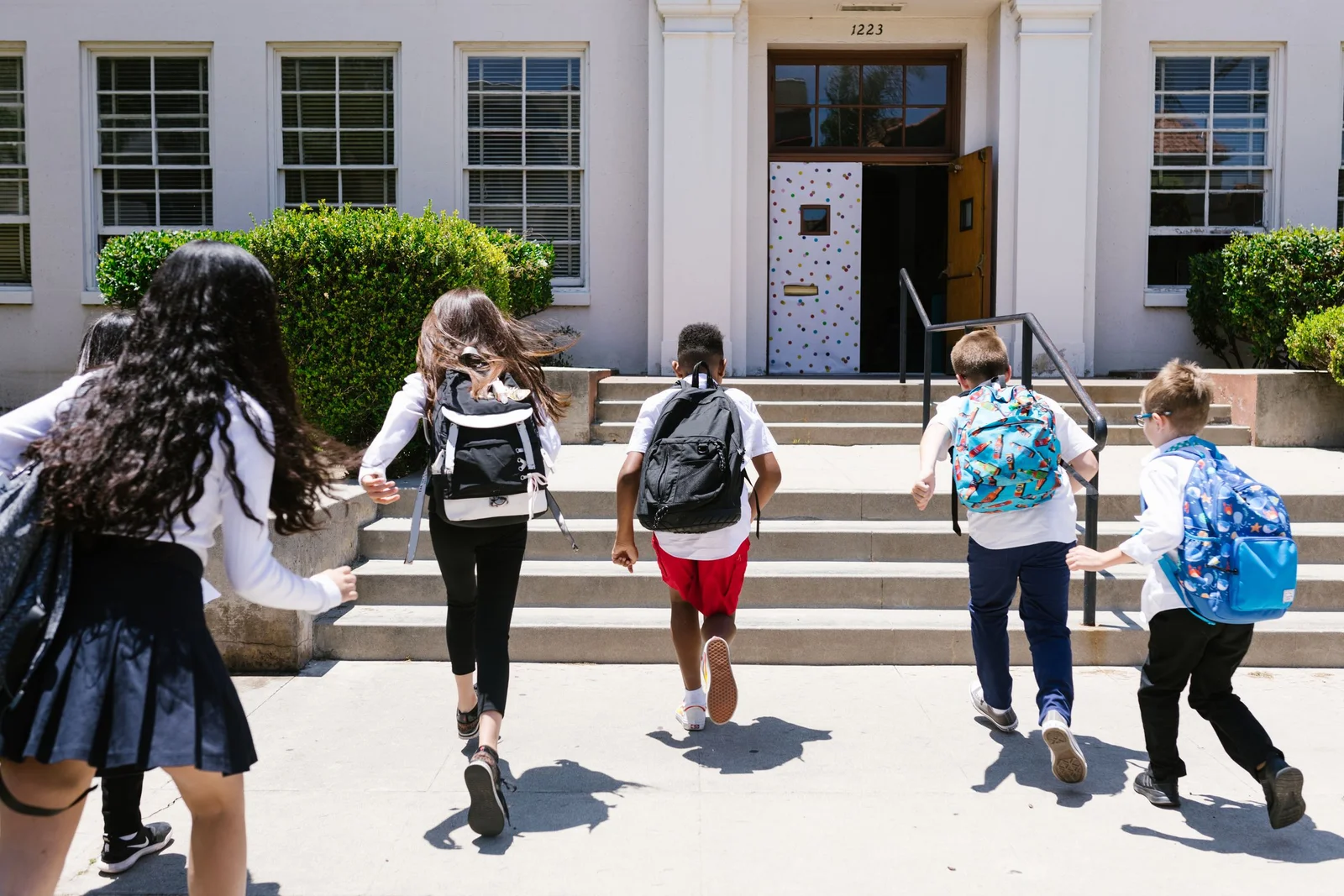
Enrolling a child in a public school in the United States is a procedure handled by the school district where the family lives: the official sources consulted show that enrollment brings together four checks — age, residence within the district, health and immunization records, and prior school history — and the immigration status of the child or the parents is not one of them. In 1982, the Supreme Court ruled, in Plyler v. Doe, that districts may not deny access to public elementary and secondary education based on that status.
The foundation: free public education and compulsory attendance defined by each state
In the United States, public elementary and secondary education is free, and the rules on entry age and compulsory attendance are set by the states: each state defines, in its own law, when a child enters kindergarten and until what age attendance is compulsory.
Florida illustrates the model. Section 1003.21 of the Florida Statutes provides that a child who turns 5 on or before September 1 of the school year is eligible for admission to public kindergarten in that year. Regular attendance is compulsory for children who are 6 years old — or who turn 6 on or before February 1 of the school year — and who have not yet turned 16.
That state calendar is what organizes the routine of newly arrived families — the same school environment in which the rules on the school bus in the United States apply.
Plyler v. Doe: what the Supreme Court decided in 1982
The central federal reference on enrollment and immigration status is a court decision. The U.S. Department of Education records that the Supreme Court held in Plyler v. Doe (457 U.S. 202, 1982) that all children in the United States have an equal right to enroll in and participate in public elementary and secondary schools, regardless of their or their parents’ immigration status.
The Department records the practical consequence: districts may not deny access to education to any child based on immigration status, and eligibility for programs supported with local, state, and federal funds is determined on the same basis as for any other student.
The Departments of Education and Justice detail the procedure in joint documents, described in the next section. It is the same system that organizes documents such as the Social Security Number — which is not an enrollment requirement, as the next section shows.
What the district checks at enrollment: age, residence, health, and records
According to the Questions and Answers document of the Departments of Education and Justice, districts may require all students to meet the proof required under state and local laws on three items: age, immunizations — or the applicable exemptions — and residence within the district.
The same document sets the condition that accompanies those requirements: the documentation rules and standards are the same for everyone, regardless of race, color, national origin, immigration status, or citizenship. And it records a concrete example: a foreign-born child who is unable or unwilling to furnish a birth certificate has the same enrollment options as a U.S. citizen child in the same situation.
In the two Departments’ joint fact sheet, the principle appears applied to two documents: enrollment may not be denied when the student or the parents choose not to provide a Social Security number, nor when a birth certificate issued abroad is presented.
Residence, in this context, is the address where the family lives within the district’s area — it is what determines each child’s school, in a country where families also navigate local rules such as Florida’s Move Over Law.
Age, health examination, and immunizations: the text of Florida law
For the health component, Florida law is Section 1003.22 of the Statutes. Under that text, each district school board requires every child admitted to kindergarten, or to any other initial entrance into a school in the state, to present a certification of a school-entry health examination performed within 1 year before enrollment.
The same section provides three adjustments. The district may adopt a policy allowing the student up to 30 school days to present the certification. Children and youth experiencing homelessness and children known to the department, as defined in the statute, receive a temporary exemption of 30 school days. And a child is exempted from the examination when the parents submit a written request stating objections on religious grounds.
As for immunizations, Section 1003.22 assigns to the Florida Department of Health, after consultation with the Department of Education, the rules on immunization against preventable communicable diseases — including the exemption procedures. The text lists the required immunizations: poliomyelitis, diphtheria, rubeola (measles), rubella, pertussis, mumps, and tetanus, in addition to other diseases determined by Department rule. The required immunizations are available at no cost from county health departments, and the corresponding certification is kept on file in the child’s immunization registry — a document step comparable to organizing the documents that make up the initial assessment of a mobility project.
English: the language support provided in federal rules
Enrollment is also the moment when the school identifies the student who is learning English. The Department of Education notes that students whose primary language is not English — English Learners — may require language supports in order to participate in school.
The Department records the legal basis for that support: Title VI of the civil rights law requires schools, districts, and state education agencies to take affirmative steps to address language barriers so that those students may participate meaningfully in educational programs.
The same official page addresses communication with families: Title VI also requires schools to communicate adequately with limited-English-proficient parents about important school-related information, in languages they can understand.
Children without stable housing: immediate enrollment under the McKinney-Vento Act
One specific situation has its own federal rule. According to materials from the National Center for Homeless Education (NCHE), a center funded by the Department of Education, the McKinney-Vento Act defines homeless children and youth as those who lack a fixed, regular, and adequate nighttime residence — including those sharing the housing of other persons due to loss of housing or economic hardship, those living in motels or camping grounds for lack of alternatives, and those living in shelters, cars, parks, or abandoned buildings.
For this group, the material lists rights defined in the law: to receive a free, appropriate public education; to enroll in school immediately, even if lacking the documents normally required for enrollment; to enroll and attend classes while the school gathers the needed documentation; and to enroll in the local school or continue attending the school of origin — the school attended when permanently housed, or the school in which the student was last enrolled — in line with each student’s best interest, with transportation to and from the school of origin.
If the district believes that the school selected is not in the student’s best interest, the same material records that the district provides the parent, guardian, or unaccompanied youth with a written explanation of its position and informs them of the right to appeal the decision.
These are frequent situations in the accounts of families who are already in the country — the same audience as this site’s content for those already in the U.S.
Frequently asked questions
Does the immigration status of the child or the parents prevent public school enrollment?
The Department of Education confirms that it does not: in Plyler v. Doe (1982), the Supreme Court held that all children have an equal right to enroll in public elementary and secondary schools regardless of that status, and districts may not deny access to education based on it.
What checks does the district perform at enrollment?
According to the Departments of Education and Justice’s Questions and Answers document, districts may require all students to provide the proof required under state and local laws: age, immunizations or the applicable exemptions, and residence within the district — with documentation standards that are the same for everyone.
Can a child without a birth certificate enroll?
The same document states that a foreign-born child who is unable or unwilling to furnish a birth certificate has the same enrollment options as a U.S. citizen child in the same situation; and, under the two Departments’ fact sheet, enrollment is not denied when a certificate issued abroad is presented, nor when the family chooses not to provide a Social Security number.
What is the entry age for public school in Florida?
Section 1003.21 provides that a child who turns 5 on or before September 1 of the school year is eligible for public kindergarten in that year; regular attendance is compulsory from age 6 — turned on or before February 1 — until age 16, subject to the exceptions in the law.
Which immunizations does Florida law list for school entry?
According to Section 1003.22, the required immunizations are against poliomyelitis, diphtheria, rubeola (measles), rubella, pertussis, mumps, and tetanus, in addition to other diseases determined by rule of the state Department of Health — which also defines the exemption procedures. The same section provides for the health examination performed within 1 year before enrollment.
School enrollment is one of the first practical steps in a move to another country — and it joins the other fronts brought together on the page to compare immigration pathways.
Disclaimer and compliance notice: Meridian Global Mobility (MGM) provides operational coordination, document organization, and logistical support for Brazil–U.S. mobility projects. MGM is not a law firm and does not provide legal services, legal advice, or representation before government agencies. Any legal services are provided independently by licensed, independent attorneys in the United States. The content of this article is informational and does not constitute consulting or an eligibility determination.
Official sources consulted
Documents, legislation, and official repositories used as references:
- U.S. Department of Education — Dear Colleague Letter: Resources for Ensuring Equal Access to Education for Immigrant Students (January 8, 2025 letter, rescinded and retained for historical purposes; records Plyler v. Doe, 457 U.S. 202, 1982)
- U.S. Departments of Education and Justice — Information on the Rights of All Children to Enroll in School: Questions and Answers for States, School Districts and Parents
- U.S. Department of Justice — Speech by Assistant Attorney General Thomas E. Perez on the 30th anniversary of Plyler v. Doe (official Plyler guidance summary: Social Security number and foreign birth certificate)
- U.S. Department of Education — Equal Education Opportunities for English Learners
- Florida Statutes, Section 1003.21 — School attendance (Online Sunshine, Florida Legislature)
- Florida Statutes, Section 1003.22 — School-entry health examinations; immunization (Online Sunshine, Florida Legislature)
- National Center for Homeless Education (U.S. Department of Education) — Supporting the Education of Children and Youth Experiencing Homelessness (McKinney-Vento)