
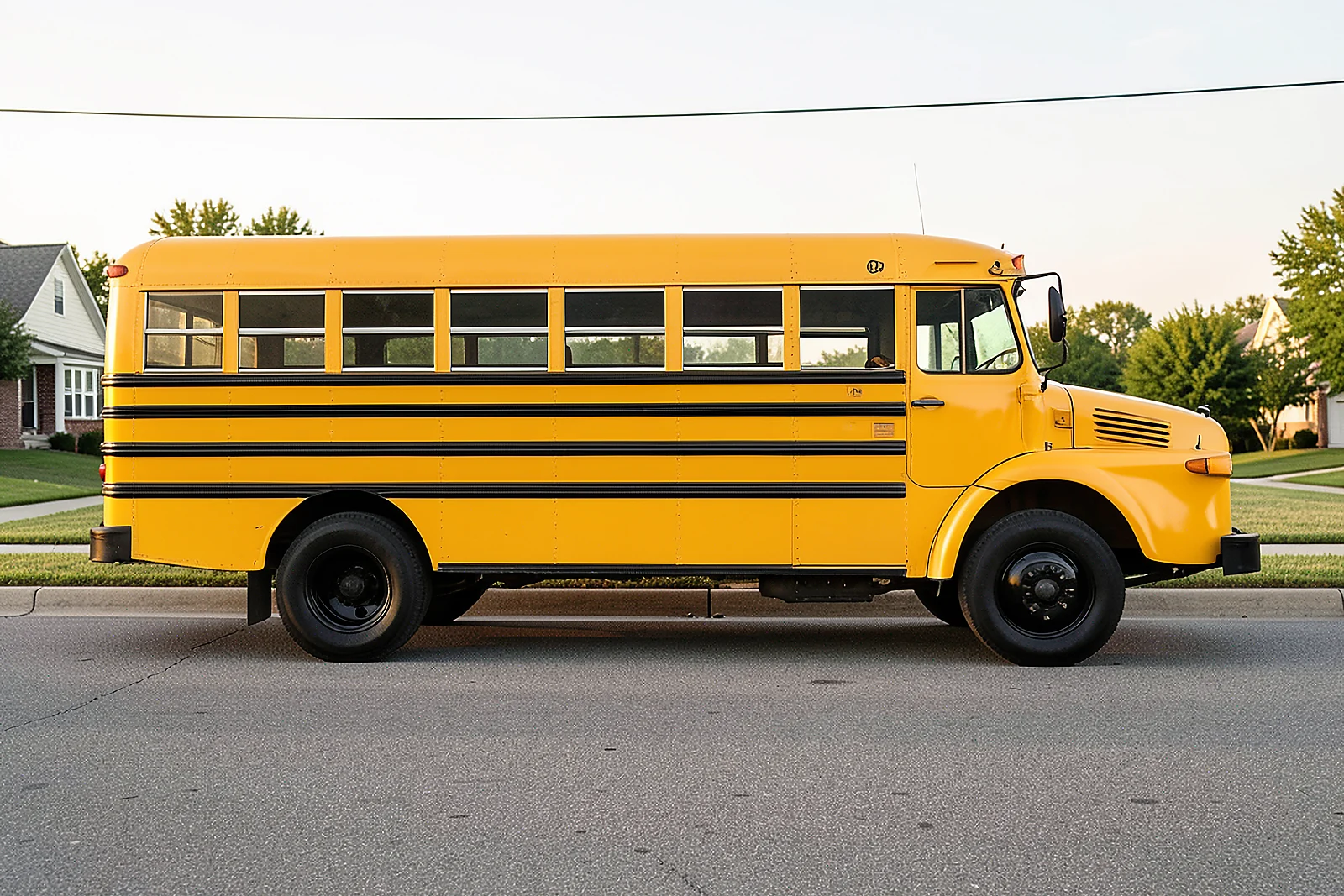
Anyone driving in the United States comes across, at school hours, a daily scene: the yellow school bus stopped at the curb, red lights flashing and the stop sign extended on its side. For that scenario, the law has a short answer — stop. In Florida, the rule is in Section 316.172 of the Florida Statutes: facing a bus with its stop signal displayed, the driver comes to a full stop, and passing is prohibited while the signal is out. It is the same universe as the article on the Move Over Law.
Florida’s rule: a full stop at the school bus’s stop signal
Section 316.172(1)(a) sets out the conduct on the state’s roads: when approaching a school bus displaying a stop signal, the driver comes to a full stop, and the bus is not passed until the signal is withdrawn. The law classifies noncompliance as a moving violation, punishable under Chapter 318 of the Florida Statutes.
On the bus’s side, Section 316.172(3) sets the stop as far to the right as possible, with warning lights and signals displayed before loading or unloading — and, where possible, away from stretches where visibility is obstructed for 200 feet in any direction.
Yellow and red: what the bus’s lights mean
NHTSA publishes the meaning of the two light signals. Flashing yellow lights indicate that the bus is preparing to stop to load or unload children — the moment when, according to the agency, traffic slows and prepares to stop. Flashing red lights, with the stop arm extended, indicate the bus stopped, with loading or unloading under way: traffic stops and moves again only when the lights go out, the arm is retracted, and the bus resumes moving.
The underlying rule is national: according to NHTSA and the U.S. Department of Transportation, it is illegal in every state to pass a school bus with flashing red lights and the stop arm extended. The stopping rules, however, are state laws, each with its own details — the ones in this article are Florida’s.
Oncoming traffic: the divided-highway exception
Section 316.172(2) carries the only exception written into the law: on a divided highway with an unpaved space of at least 5 feet, a raised median, or a physical barrier between the directions, traffic traveling opposite the bus does not stop. The exception is defined by those three physical elements.
That is the case of the multi-lane avenue divided only by paint: with none of the three elements between the directions, both sides stop — the traffic behind the bus and the oncoming traffic — and, in the bus’s direction, every lane stops.
The reason is the protection of the students: a child does not always cross in front of the bus — sometimes, behind it, out of passing drivers’ view. The transportation serves elementary, middle, and high school students.
Passing on the boarding side: a mandatory hearing
One case receives added severity. Under Section 316.172(1)(b), passing on the side where children board and alight, with the signal displayed, is also a moving violation — and it carries a mandatory hearing, under Section 318.19. It is the side of the door and the boarding point, the one with the statute’s strictest treatment — an everyday record alongside obligations such as notifying USCIS of a change of address on Form AR-11.
The penalty provided: a US$ 100 minimum and suspension on a repeat violation
The civil penalty appears in Section 318.18(5): according to the official analysis by the Florida Senate staff, a driver who fails to stop at the school bus’s stop signal is subject to a minimum of US$ 100. On a repeat violation within 5 years, the same provision provides for suspension of the driver’s license by the DHSMV, the state department of highway safety.
Cameras on school buses: enforcement by image
Florida added an enforcement instrument. Under Section 316.173, school districts may install school bus infraction detection systems on buses — cameras that record violations of Section 316.172(1)(a) and (b): passing the stopped bus and passing on the boarding side. Equipped buses display, on a rear plate, “STOP WHEN RED LIGHTS FLASH” and “CAMERA ENFORCED”.
New programs begin with a 30-day public awareness campaign with warnings only. Afterward, law enforcement mails the registered owner the notice of violation, with images, date, time, place, and the penalty amount. The owner has 30 days from the mailing to pay the penalty under Section 318.18(5) or submit an affidavit; without one of the steps, court costs and the issuance of a uniform traffic citation apply. The notice includes the instructions for requesting a hearing and contesting.
The school bus nationwide: the safest vehicle on the road and NHTSA’s numbers
The national context comes from NHTSA and the U.S. Department of Transportation: the school bus is the safest vehicle on the road — less than 1% of traffic deaths involve school transportation vehicles.
NHTSA’s numbers quantify that risk. Between 2015 and 2024, 1,069 people died in 962 fatal crashes related to school buses — an average of 107 per year. Among the victims were 204 school-age children, including 77 pedestrians and 39 occupants of the bus. From 2000 to 2024, 63 people died in crashes with drivers who illegally passed stopped buses — nearly half of them pedestrians aged 18 or younger.
NHTSA also publishes the bus stop practices: arriving at least 5 minutes early; waiting at least 10 feet from the road — the agency’s five giant steps; never walking behind the bus; and, if something drops near it, telling the driver rather than picking it up. The U.S. Department of Transportation also records that children do not judge the speed of vehicles well. The bus stop routine is part of the documents and records that organize the life of anyone living in the country.
Last week, National School Bus Safety Week 2026 (October 19 to 23) concentrated state enforcement and awareness campaigns about illegally passing school buses.
Frequently asked questions
Does oncoming traffic have to stop too?
The rule reaches both directions, with a single written exception: the divided highway with an unpaved space of at least 5 feet, a raised median, or a physical barrier — in which case oncoming traffic does not stop. The avenue divided only by paint is none of the three cases: both sides stop.
What do the bus’s yellow and red lights mean?
According to NHTSA, flashing yellow lights announce the bus preparing to stop to load or unload children. Flashing red lights, with the arm extended, indicate the bus stopped — and traffic moves only when the lights go out, the arm is retracted, and the bus resumes moving.
What is the penalty for not stopping in Florida?
Section 316.172 classifies the conduct as a moving violation, punishable under Chapter 318; Section 318.18(5) sets the minimum civil penalty of US$ 100 and the suspension of the license on a repeat violation within 5 years. Passing on the boarding side carries a mandatory hearing.
How does a camera-recorded citation work?
Under Section 316.173, school districts may install infraction detection systems on buses. Law enforcement mails the registered owner a notice with images, date, time, place, and amount. The owner has 30 days from the mailing to pay or submit an affidavit and request a hearing, as per the notice. New programs begin with 30 days of warnings only.
Is the stopping rule the same in every state?
The starting point is national: according to NHTSA, it is illegal in every state to pass a school bus with flashing red lights and the stop arm extended. The details are state laws and vary — the ones in this article are Florida’s. Other records of life in the country, such as the Social Security Number, have their own guides on this site.
The state’s traffic rules are part of the practical information of any mobility project — from living legally in the U.S. to the immigration pathways, such as the EB-2 NIW category, explained in its own article.
Disclaimer and compliance notice: Meridian Global Mobility (MGM) provides operational coordination, document organization, and logistical support for Brazil–U.S. mobility projects. MGM is not a law firm and does not provide legal services, legal advice, or representation before government agencies. Any legal services are provided independently by licensed, independent attorneys in the United States. The content of this article is informational and does not constitute consulting or an eligibility determination.
Official sources consulted
Official documents, legislation, and repositories used as references:
- Florida Statutes, Section 316.172 — Florida Senate (Florida Legislature)
- Florida Statutes, Section 316.173 — Florida Senate (Florida Legislature)
- National Highway Traffic Safety Administration — School Bus Safety
- U.S. Department of Transportation — Safety Advisory: Students and Motorists Reminded to Be Safety Conscious In and Around School Buses
- Florida Senate — official staff analysis (penalty under Section 318.18(5))